.svg)

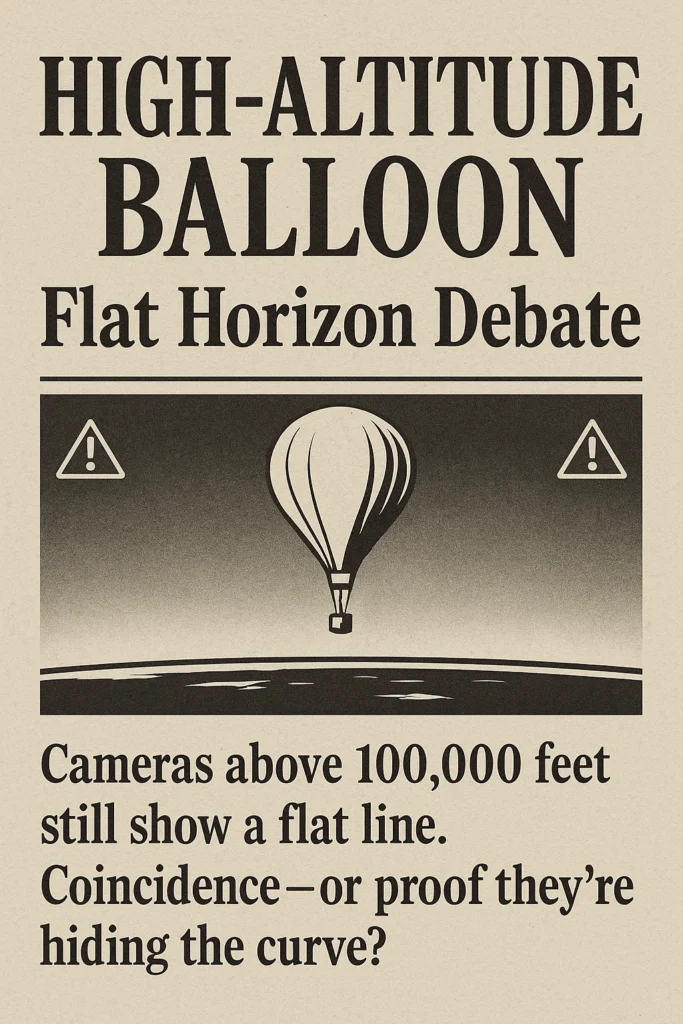
The high-altitude balloon flat horizon debate has been floating around—literally—for years. Every time a balloon goes up past the clouds, someone posts the footage, and the internet divides faster than a politician’s promises. Is the Earth curved? Or does the horizon stubbornly remain… flat?
The Rise of the High-Altitude Balloon Flat Horizon Debate
It all started with hobbyists, science enthusiasts, and curious truth-seekers sending cameras into the stratosphere. They attached them to weather balloons, GoPros, and sometimes very questionable duct-tape rigs. The goal? Capture a clear view of the Earth from the edge of space.
But here’s where it gets interesting. Instead of dramatic curvature, many of these videos show a steady, unbroken, flat-looking horizon—even at altitudes of over 100,000 feet. For flat Earth supporters, this isn’t just a coincidence; it’s evidence.
Meanwhile, mainstream science insists the curvature is subtle and can’t be seen clearly without extreme altitude or a wide enough field of view. Still, the footage sparks more questions than it answers.
Why Does the Horizon Look Flat at High Altitude?
From the official perspective, the high-altitude balloon flat horizon is an optical illusion. They argue that the Earth’s curve is gentle—so gentle that it’s barely visible at those heights unless you use specific camera lenses. Operation Fishbowl: Did the Nukes Hit the Firmament?
Flat-earthers counter that a horizon staying perfectly level across the entire frame is exactly what you’d expect if Earth wasn’t a globe at all. And if curvature exists, shouldn’t it be more obvious when you’re above the clouds?
Another point? In some clips, as the camera pans, the horizon rises to eye level instead of dropping away. Mainstream physics explains this as perspective. Flat-earthers say it’s proof the horizon isn’t curving away from you—because it can’t.
The Role of Lenses in the High-Altitude Balloon Flat Horizon Argument
A big part of the debate comes down to lenses. Wide-angle and fisheye lenses can bend straight lines, making horizons look curved—even when they’re not. Narrower lenses, on the other hand, tend to capture a flatter view.
This leads to an awkward reality: you can watch two balloon videos filmed on the same day, from the same height, and get completely different horizons depending on the lens used. That’s perfect fuel for both sides.
Flat-earthers often prefer footage from non-fisheye cameras, claiming it shows the horizon’s true shape. Globe defenders prefer wide-angle shots that seem to display curvature—though critics argue that’s lens distortion, not reality.
How Weather Conditions Affect the Horizon
Altitude alone doesn’t tell the full story. Lighting, atmospheric haze, and even cloud formations can influence how the horizon appears.
Clear days can produce sharp, uninterrupted lines. Hazy or cloudy conditions blur the horizon, making it harder to judge shape or curvature. This variability means that even balloon launches with identical equipment can produce drastically different footage.
What’s the ‘True’ Horizon?
Defining the “true” horizon isn’t as simple as you’d think. If the Earth is a globe, the horizon should drop lower as you ascend. But balloon footage often shows it staying at eye level, which challenges that assumption.
Science explains this by saying our eyes naturally adjust to keep the horizon in the centre of our view. Flat Earth researchers argue that’s an excuse for why the expected curve isn’t obvious.
Why Footage from High-Altitude Balloon Flat Horizon Launches Gets People Talking
Every time new footage emerges, it sparks online battles. The simplicity of the experiment—balloon, camera, launch—makes it hard to dismiss the results as complex trickery.
For those questioning the globe, this is relatable science anyone can try. For those defending it, the lack of clear curvature becomes a teachable moment about optics, perspective, and human expectation.
And let’s be honest—it’s far more entertaining than most reality TV.
Who Controls the Narrative?
If the Earth is indeed curved, why does so much amateur footage appear flat? Mainstream sources insist it’s because the human eye and most cameras can’t detect the gentle curve at such altitudes.
Flat-earthers claim it’s because the curve isn’t there at all—and that official agencies use selective footage to reinforce the globe model. The truth? Both sides present evidence, but the interpretation depends entirely on your starting belief.
Why This Debate Isn’t Going Away
The high-altitude balloon flat horizon topic endures because it’s visual. You don’t need a physics degree to watch a balloon video and form an opinion. That accessibility means thousands of people around the world are running their own launches, comparing results, and sharing them online.
And every new launch, whether it shows a curve or not, fuels the cycle all over again.
Conclusion: The Horizon Problem
At the end of the day, the high-altitude balloon flat horizon question boils down to interpretation. The footage is there. The experiments are simple. The conclusions? That’s where things get complicated.
Whether you see a curve or a flat line might depend more on what you believe before watching than on the footage itself. But one thing’s for sure—until someone takes a balloon higher than ever before and captures indisputable proof, the horizon debate will keep rising.