
.svg)

Apollo 11 Facts – The Mission That Doesn’t Add Up
Apollo 11 facts are repeated like gospel. Schoolbooks tell us man set foot on the Moon, Armstrong gave his immortal line, and the world watched in awe. Yet when you actually dig beneath the surface, Apollo 11 facts raise more questions than answers. From fuel margins to missing hardware, the story becomes less about triumph and more about theatre.
The Official Tale
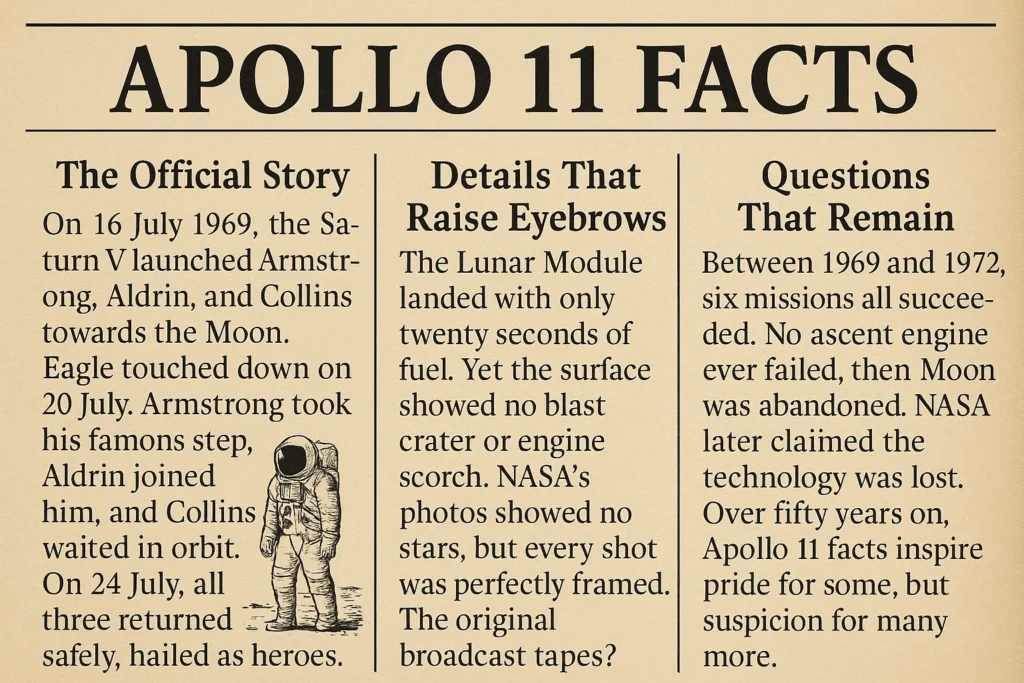
apollo-11-facts. The official tale is polished. On 16 July 1969, the Saturn V launched Neil Armstrong, Buzz Aldrin, and Michael Collins from Florida. Four days later, Armstrong and Aldrin descended to the Moon in the Lunar Module Eagle. They planted a flag, took some photos, collected rocks, and lifted off to meet Collins in orbit. On 24 July, the cone-shaped Command Module splashed down in the Pacific. End of story, or so we are told. Flat Earth Maps-Are We All Living on a Cosmic Pancake?
Apollo 11 facts – Fuel and Weight
But Apollo 11 facts are not that simple. Let’s start with fuel. Armstrong landed Eagle with only twenty seconds left in the tanks. That is not engineering margin, that is divine luck. According to NASA’s own transcript, the call of “30 seconds” came just before touchdown — meaning their buffer was razor thin. The ascent stage was no better. It carried about 2,400 kilograms of fuel and relied on one small engine. No backup. If it failed to ignite, Armstrong and Aldrin were staying put forever. Yet it fired perfectly, first time, every time, across six missions.
Weight was another problem. The Lunar Module looked like a flying garden shed wrapped in tinfoil. Half of its mass was fuel, the rest was paper-thin walls and spindly legs. It barely looked fit to hold together on Earth, let alone in lunar vacuum.
Blast Crater and Photos
Then there is the missing blast crater. An engine strong enough to slow a spacecraft should have scoured the ground. Yet the landing site looks untouched. No scorched patch, no crater, hardly any dust disturbed. The photos show legs as clean as showroom chrome. Speaking of photos, they are suspiciously perfect. Astronauts wore thick gloves, had chest-mounted cameras with no viewfinders, and yet produced hundreds of perfectly centred, exposed images. Not a single blurry shot. And not a single star. NASA says the exposure settings washed them out. Critics say a studio set is easier to explain.
apollo-11-facts-Radiation
The radiation problem is rarely discussed. To reach the Moon, Apollo 11 had to cross the Van Allen belts. These zones of high-energy particles are no joke. At the time, shielding was little more than aluminium skin. NASA claims the crew passed through quickly enough to avoid danger. Yet even today, NASA’s own Orion programme lists radiation as a key challenge for future deep space travel. Somehow, Apollo astronauts breezed through without so much as a rash.
Re-entry
Re-entry was another miracle. Apollo 11’s Command Module hit Earth’s atmosphere at 25,000 mph. The angle had to be exact. Too shallow and it bounced off into space. Too steep and it burned up. This had never been tested with humans. Yet they got it right first time and then repeated the trick five more times without a hitch.
Docking
Apollo-11-facts. Docking is another puzzle. The Lunar Module had to blast off the Moon, chase down the Command Module, and lock on in orbit. Before Apollo 11, NASA had only tried this manoeuvre twice: Apollo 9 in Earth orbit and Apollo 10 as a rehearsal. That means Apollo 11 was only the third live trial. Yet Armstrong and Aldrin supposedly launched from the surface, flew a tin can into orbit, and docked perfectly with Collins. No backup engine, no second chance, and somehow no mistakes across six missions. That is not engineering. That is choreography.
The Vanishing Act
Then comes the vanishing act. The public only ever saw the scorched cone splash into the Pacific. Where did the rest of the rocket go? The Saturn V stages were jettisoned and left to burn or drift. The Lunar Modules were abandoned in orbit or “crashed into the Moon.” The Service Modules were cast off before re-entry. In short, all the expensive hardware simply disappeared. No evidence, no debris, nothing for anyone to check. Only the nose cone returned, conveniently small enough to display in a museum. These are apollo-11-facts.
And if all that hardware is still up there, why can’t we see it? We can observe galaxies millions of light years away in detail, but we cannot zoom in on a lander supposedly sitting just 240,000 miles away. Astronomers argue this is due to resolution limits, but for many that explanation sounds as flimsy as the Lunar Module itself.
Final Thoughts
So where do Apollo 11 facts leave us? The official story tells of courage, genius, and victory in the space race. The anomalies tell of fuel margins thinner than a razor blade, missing craters, erased tapes, untested systems that never failed, and billions of dollars’ worth of machinery that vanished without trace. NASA admitted in 2006 that the original high-quality recordings of Apollo 11 were “accidentally erased,” which only fuels doubt further. Perhaps Apollo 11 was mankind’s greatest achievement. Or perhaps it was mankind’s greatest stage show, played out for Cold War prestige. Either way, Apollo 11 facts remain the gift that keeps on giving — for those willing to question. Flat earth files UK