.svg)

Buying Sunlight: The Sky’s Latest Sales Pitch
Marketers promise daylight on demand. Engineers promise mirrors in orbit. Politicians promise oversight soon. Meanwhile, you and I squint at the sky. Moreover, we ask simple questions before anyone touches a giant space mirror. Therefore, let’s unpack the pitch, the physics, and the fallout. For fun and clarity, I call this the Buy Sunlight expose.
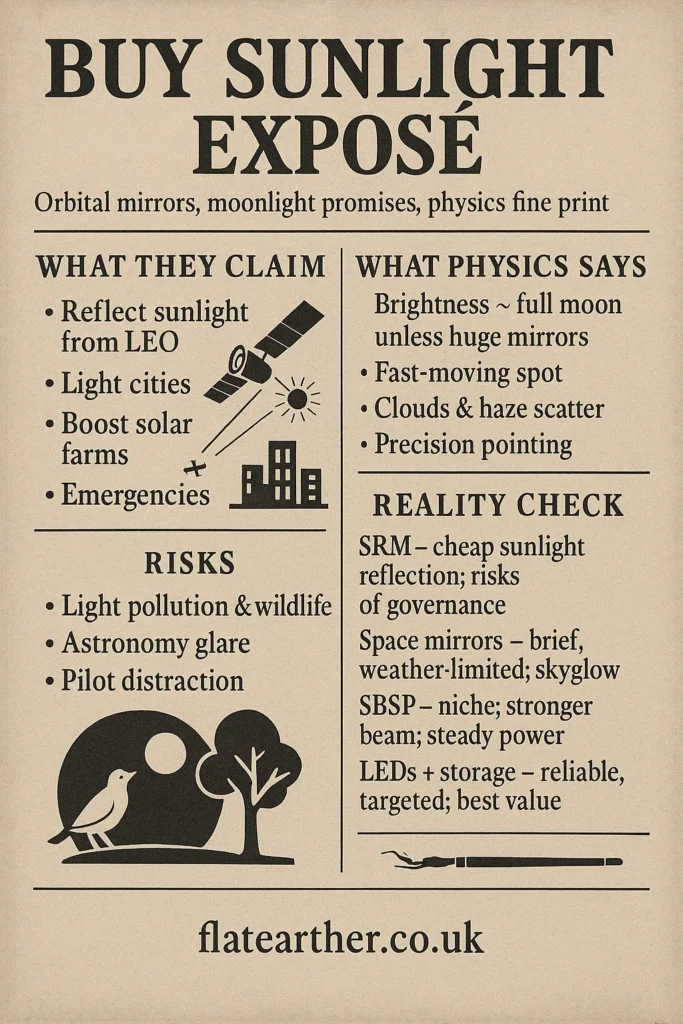
Buy Sunlight expose: what they claim
Firstly, the sales deck sounds slick. Put a shiny reflector in low orbit. Then steer a bright spot across a city. Therefore, extend evening light, boost solar farms, and impress investors. Moreover, the pitch adds emergency lighting for disasters and festivals. Additionally, it promises “clean light” without streetlamps or diesel generators.
However, targets move fast under an orbiting mirror. Consequently, the light races across the ground. Hence, cities receive minutes, not evenings, unless fleets fly in formation. Furthermore, clouds block the beam, always. Thus, the mirror fails when bad weather arrives, which is precisely when you want light. According to the Buy Sunlight expose crowd, upgrades fix everything. Yet upgrades usually add mass, cost, and complexity.
Secondly, promoters hint at precision. They say guidance keeps the spot steady. However, guidance needs energy, sensors, and control authority. Moreover, the spot still smears with thin cloud and haze. Therefore, claimed brightness on slides rarely matches street reality. Ultimately, the dream looks sleek on paper. Yet reality prefers friction, drag, and billing cycles.
Buy Sunlight expose: what the physics says
Firstly, brightness matters. A small mirror throws a small beam. Therefore, you need huge reflectors or many satellites. Moreover, bigger mirrors hate launch vibrations and micrometeoroids. Additionally, thermal warping bends the shape and blurs the spot.
Secondly, motion rules the game. Low orbits whip around the planet quickly. Consequently, the light does not linger without constant choreographing. Meanwhile, geostationary orbits sit far away. Thus, mirrors there would need impossible sizes to matter.
Thirdly, the environment pays. Night-time wildlife steers by darkness. Therefore, sudden skyglow scrambles migration, hunting, and rest. Moreover, astronomers already fight bright satellite streaks. Consequently, mirrors magnify the glare problem. Furthermore, pilots dislike unexpected dazzle near approaches. Hence, regulators will demand strict windows, zones, and cut-offs.
Finally, economics bite. Batteries and storage keep improving on Earth. Therefore, extending solar output with space mirrors struggles to compete. Additionally, ordinary lighting stays cheap, targeted, and flexible. Consequently, city treasurers will ask hard questions about costs, risks, and liability. For balance, the Buy Sunlight expose also notes rare niches. Disaster relief, remote outposts, and art events may still tempt buyers. SRM Weather modification
FAQs for the Buy Sunlight expose
Can mirrors replace streetlights?
Not realistically. Moreover, streetlights deliver steady, local light. Mirrors deliver brief, sweeping light.
Could mirrors power solar farms at night?
Perhaps a little. However, reflected irradiance stays modest without monstrous mirrors. Therefore, storage wins most comparisons.
What about clouds?
Clouds always win. Additionally, haze scatters the beam and cuts brightness sharply.
Is this safe for eyes and pilots?
Operators can design limits and shutters. However, authorities will still restrict angles and timings.
Who pays when wildlife suffers?
Great question. Moreover, liability frameworks lag behind the sales deck. Therefore, someone will hold the bill.
The bottom line on the Buy Sunlight expose
Firstly, the idea is bold, catchy, and very marketable. However, physics remains unimpressed. Moreover, ecology, astronomy, and aviation raise red flags quickly. Additionally, economics favours storage, LEDs, and design fixes here on Earth. Consequently, large-scale “sun sales” look like moonlight with better PR.
So, what should we do instead? Firstly, we fix cities the boring way. Plant trees, add shade, and design cool roofs. Moreover, we upgrade lighting with smarter controls and better optics. Additionally, we build storage near solar and wind. Consequently, we keep grids stable without sky theatrics.
Secondly, we write guardrails before gadgets launch. Therefore, demand public trials, open data, and strict cut-off rules. Moreover, protect wildlife corridors and dark-sky sanctuaries. Additionally, require liability bonds and independent monitoring. Thus, promoters share the risks as well as the headlines.
Thirdly, we keep our humour. Space mirrors suit a glossy keynote. However, daily life needs reliability, not stunts. Meanwhile, the Buy Sunlight expose reminds us to follow the incentives. Who profits from hardware in orbit? Who pays for the consequences on the ground?
Finally, we remember the bigger picture. Some people also push SRM and other climate “dimmer switches”. Therefore, we must ask similar questions everywhere. Who sets the dial? Moreover, who says stop? Additionally, what happens to food, health, and trust? Consequently, we insist on consent first, not last.
Closing wink: If someone offers to sell you daylight, check the clouds, check the bill, and check the exit plan. Moreover, keep both feet on the ground while you look up. Ultimately, that balance keeps the lights on, the skies dark when needed, and the jokes sharp.