.svg)

Climate chat gets dramatic fast; therefore, let’s keep our feet on the ground.
SRM weather modification is the shiny idea of dimming the sun a touch.
Supporters say it could cool things quickly. However, the paperwork screams “handle with care.”
Moreover, history shows “small tests” often grow legs.
So, we read the documents, follow the money, and keep our humour.
Ultimately, we want clarity, sunlight, and consent — in that order.
If someone wants a global dimmer switch, we want the manual.
SRM weather modification: How it works in practice
Firstly, SRM weather modification reflects a slice of sunlight back to space.
Moreover, it does not remove carbon or fix acidic seas.
Therefore, it treats a symptom while causes march on. For a covert, real-world campaign, see Operation POPEYE — Make Mud, Not War.
Main approaches, kept punchy:
-
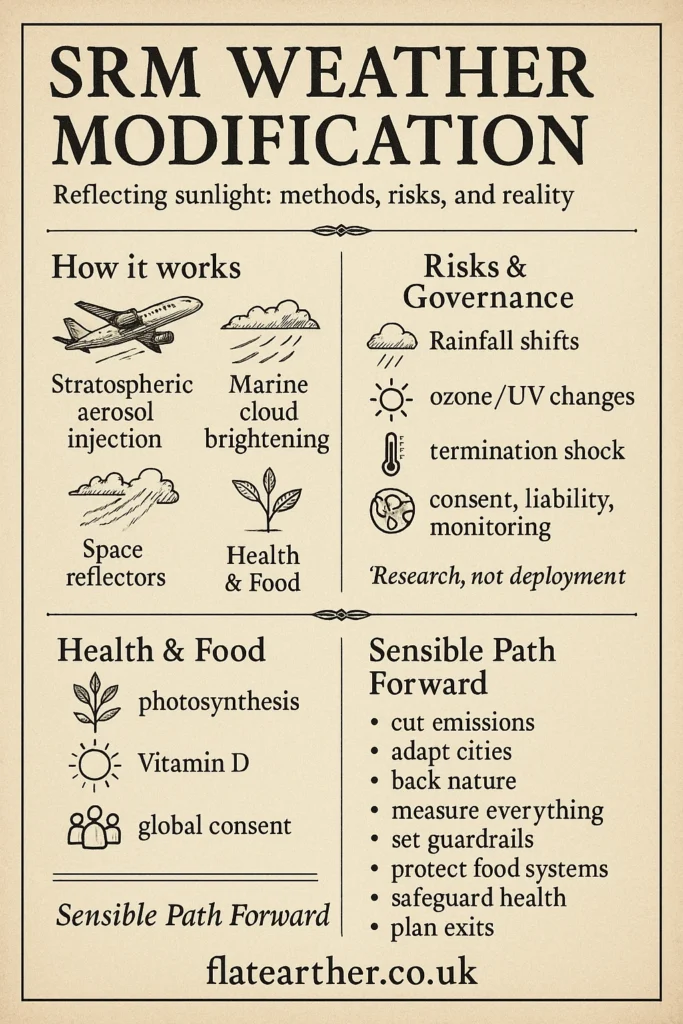
Stratospheric aerosol injection: Aircraft release reflective particles high above weather. Consequently, less sunlight reaches the surface.
-
Marine cloud brightening: Sea salt spray fattens low clouds. Therefore, they bounce more light away.
-
Cirrus thinning: Ice clouds get tweaked so night heat escapes. Hence, outgoing radiation rises slightly.
-
Space reflectors: Mirrors in orbit. However, the price tag says “dream on.”
Additionally, every method needs dense monitoring and open data.
However, unilateral moves could shuffle rainfall and trigger disputes.
Consequently, permits, liability, and public reporting are non-negotiable.
Ultimately, SRM weather modification might cool averages while upsetting local rhythms.
SRM weather modification: Risks, governance, and real-world implications
Firstly, rainfall may move, strengthen, or stall.
Moreover, monsoons and drought timing could change in awkward ways.
Additionally, stratospheric chemistry might shift, nudging ozone and surface UV.
Furthermore, crops dislike surprises in light and rain.
Likewise, people need Vitamin D; dimmer UV makes that harder.
However, models still show cooling potential under steady operation.
Consequently, trials require baselines, sensors, and independent audits.
Therefore, SRM weather modification must not proceed without consent, liability, and open data. HAARP UK — High-Frequency Research or Weather Control?
Key risks to weigh carefully
-
Firstly, rainfall redistribution creates winners and losers.
-
Secondly, UV and ozone changes hit health and ecosystems.
-
Thirdly, “termination shock” bites if operations stop suddenly.
-
Finally, geopolitics gets spicy when skies become strategy.
Governance, such as it is
-
Presently, hostile weather warfare is banned; peaceful research is watched.
-
Moreover, biodiversity rules push for tiny, controlled studies only.
-
Additionally, national papers repeat “research, not deployment.”
-
Meanwhile, regulators are eyeing startup stunts with sulphur balloons.
-
Ultimately, communities ask for consent frameworks and real-time transparency.
Health and food: practical stakes of SRM weather modification
Firstly, sunlight feeds plants and people.
Moreover, SRM weather modification could lower surface light in some regions.
Consequently, yields may drop if light dips during key growth stages.
However, diffuse light sometimes helps leaves deeper in the canopy.
Therefore, results vary by crop, season, and latitude.
Furthermore, humans need UVB for Vitamin D.
Hence, reduced UV could deepen winter deficiencies.
Likewise, livestock rely on pasture quality and timing.
Accordingly, shuffled rains and dimmer days can bite farm margins.
Meanwhile, oceans need light for phytoplankton.
Therefore, tweaks at the top can ripple down food webs.
Ultimately, health and food sit on the front line, not the footnotes. Buy Sunlight Expose.
SRM weather modification: Ethics, consent, and control
Firstly, nobody gets to set a global thermostat alone.
Moreover, SRM weather modification demands prior, informed, worldwide consent.
Additionally, liability must be clear before any nozzle opens.
However, consent means power, voice, and the right to say “no.”
Consequently, trials must publish inputs, methods, and outputs in real time.
Furthermore, independent monitors should track aerosols, clouds, and radiation.
Likewise, farmers and indigenous leaders deserve seats at the table.
Therefore, engineering follows social permission, not the reverse.
A sensible path forward
Firstly, fix causes while studying tools.
Moreover, keep research small, slow, and supervised.
Additionally, prioritise food, health, and water security.
Consequently, reduce risks before touching the dial.
Steps that make sense now
-
Cut emissions fast: Clean energy, cleaner air, better health.
-
Adapt smarter: Trees, shade, water, and cool buildings without dimming daylight.
-
Back nature: Forests, wetlands, and soils steady climate and floods.
-
Measure everything: Public sensors for aerosols, clouds, light, rain, and crops.
-
Set guardrails: Permits, open data, real-time reporting, and independent audits.
-
Ban unilateral moves: No solo sky hacks by firms or states.
-
Protect food systems: Crop trials, daylight standards, and farmer support.
-
Safeguard health: Track UV, Vitamin D, air chemistry, and wellbeing.
-
Plan exits: Design termination protocols and long-term funding now.
Bottom line: SRM weather modification may shave heat; SRM weather modification may also shuffle rain, nutrition, and trust. Therefore, eyes open, papers on the table, and no surprises above our heads.