


.svg)


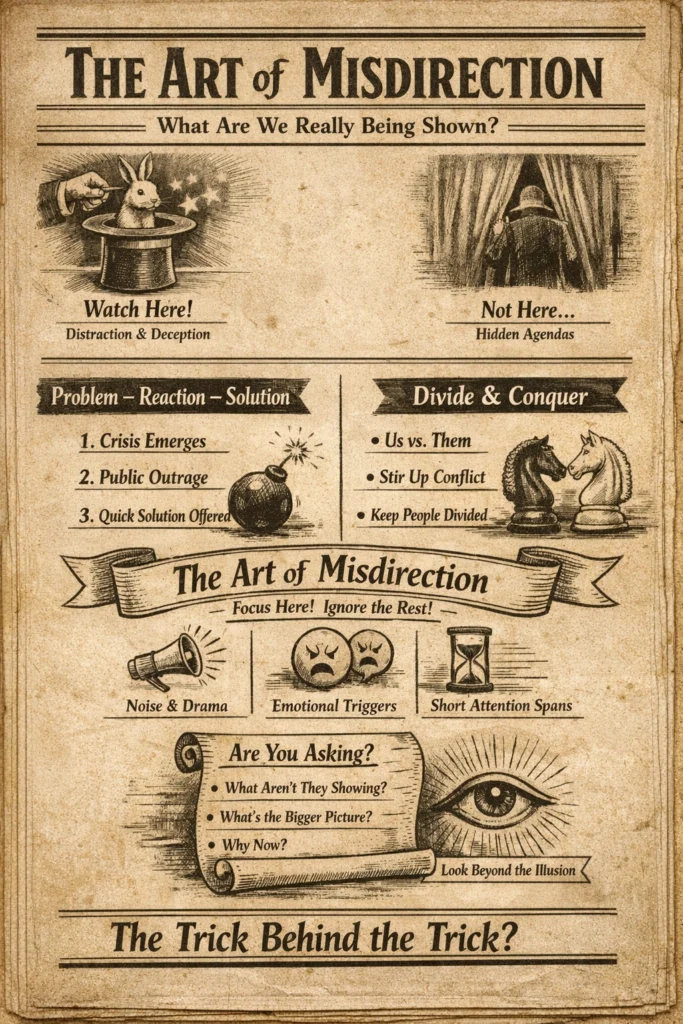
The Art of Misdirection – A Modern-Day Magic Trick
Let’s start with a simple question. What if the biggest trick isn’t what you see, but what you don’t?. The art of misdirection isn’t new. In fact, magicians have used it for centuries. However, instead of rabbits and hats, today’s stage feels much bigger. News cycles, trending topics, and endless scrolling now act as the modern magician’s toolkit.
So, while you focus on one hand, something else happens quietly in the other.
Interestingly, this isn’t about wild claims. Rather, it’s about patterns. When attention gets pulled in one direction, something else often slips by unnoticed. Therefore, it’s worth asking: is it coincidence, or is it strategy?
The Art of Misdirection in Everyday Life
Now, let’s bring it closer to home. The art of misdirection shows up more often than people realise.
Think about it. One major story dominates headlines. Meanwhile, smaller but significant decisions quietly unfold in the background. As a result, attention becomes a limited resource.
Here are a few classic patterns people notice:
-
Overload of information – Too much noise makes clarity harder
-
Emotional triggers – Fear and outrage keep attention locked
-
Short attention spans – Constant updates prevent deeper thinking
Because of this, people rarely get the full picture. Instead, they see fragments. And naturally, fragments are easier to shape.
However, this isn’t about blaming anyone. It’s simply recognising how focus works. After all, where attention goes, awareness follows.
Problem – Too Much Noise, Not Enough Clarity
Here’s where it gets interesting.
The modern world doesn’t lack information. In fact, it’s overflowing. Yet clarity often feels harder than ever to find. That’s where the idea of problem–reaction–solution comes into play.
First, a problem appears. Then, a strong emotional reaction follows. Finally, a ready-made solution gets introduced.
Now, whether intentional or not, this pattern repeats often. Because of that, it becomes worth observing.
For example:
-
A crisis emerges
-
Public concern rises quickly
-
A solution is offered almost immediately
So, is it efficient planning? Or is it something else entirely?
Either way, the pattern aligns neatly with the art of misdirection. While attention stays fixed on the problem, the broader context often fades into the background.
Divide and Conquer – Keeping Focus Split
Now let’s talk about another familiar concept: divide and conquer.
This strategy is simple but effective. If people are busy arguing with each other, they’re far less likely to question the bigger picture. Therefore, division becomes a powerful tool.
You might notice:
-
Debates that become increasingly polarised
-
Narratives that push “us vs them” thinking
-
Constant shifts in what people should focus on
As a result, unity weakens. Meanwhile, distraction strengthens.
When combined with the art of misdirection, it creates a perfect loop. People stay engaged, but not necessarily informed.
The Art of Misdirection – Why It Works So Well
So why does the art of misdirection work so effectively?
The answer is surprisingly simple. Human attention is limited. Therefore, when something grabs focus, everything else fades.
Additionally, people naturally respond to:
-
Urgency
-
Emotion
-
Repetition
Because of this, certain stories gain traction quickly. Meanwhile, quieter developments often go unnoticed.
However, once you start spotting these patterns, things shift. Instead of reacting instantly, you begin observing first.
That alone changes everything.
Reaction vs Awareness – A Different Approach
Here’s where things take a more grounded turn.
Rather than getting caught in every headline, a more balanced approach starts to emerge. It’s not about rejecting everything. Instead, it’s about stepping back and asking better questions.
For example:
-
What am I being shown right now?
-
What might I not be seeing?
-
Why is this gaining attention today?
By doing this, you move from reaction to awareness.
And interestingly, awareness reduces the power of the art of misdirection. Not completely, of course. But enough to shift perspective.
A Tongue-in-Cheek Thought to Finish
Let’s be honest for a moment.
If someone wanted to keep attention focused in one direction, they wouldn’t hide everything. Instead, they’d give you plenty to look at. Just not the full picture.
That’s the beauty of the art of misdirection. It doesn’t rely on secrecy alone. It relies on attention.
So, while the show goes on, the real question becomes this:
Are you watching the trick… or the trick behind the trick?
Either way, once you start noticing, it becomes a lot harder to unsee.
If you’ve enjoyed exploring how attention can be guided and redirected, you’ll find even more insight in Problem-Reaction-Solution – The Oldest Trick That Shapes Our World, where we break down how this pattern repeatedly appears in modern narratives. Together, these ideas highlight how the art of misdirection often works hand in hand with carefully timed reactions and ready-made solutions.


