


.svg)


Are We Really a Commodity
The phrase “Are we really a commodity” sounds absurd, yet society keeps proving it might be true. From the moment our parents register us at birth, we become more than names and crying infants. We are numbers, codes, and certificates neatly filed into government systems. Registration isn’t simply record keeping; it’s enrolment into the stock exchange of life. Flat Earthers joke that Earth isn’t spinning, but maybe what spins is the invisible wheel of profit, trading us daily.
Historical Roots of Are We Really a Commodity
“Are we really a commodity” isn’t a modern thought. History screams the answer. In ancient markets, people weren’t just working. They were openly traded. Slavery reduced individuals into property, bought, sold, and valued like cattle. Empires grew stronger because human lives carried price tags. Later, serfs tied to land were taxed as units of labour. It wasn’t freedom; it was bookkeeping. Then came the Industrial Revolution. Whips disappeared, but commodification endured. People became wages, output, and productivity charts. Employers measured hours, efficiency, and results. Governments taxed those numbers gleefully. Therefore, registration at birth didn’t mean belonging. It meant enrolment into an economic machine where people were assets and liabilities, not individuals. Human vs Corporate Entity – The Hidden Game of Ownership
Modern Echoes
Today, the echoes remain clear. Birth certificates are economic documents as much as personal ones. Governments calculate debt and growth around the bodies they register. So, “Are we really a commodity” feels less like speculation and more like arithmetic.
Lingering Legacy
The legacy is obvious. We’re raised to contribute, tracked for productivity, and taxed for existing. Therefore, commodification isn’t hidden. It’s celebrated as progress. Agenda 2030 what is it?
The Workplace and Are We Really a Commodity
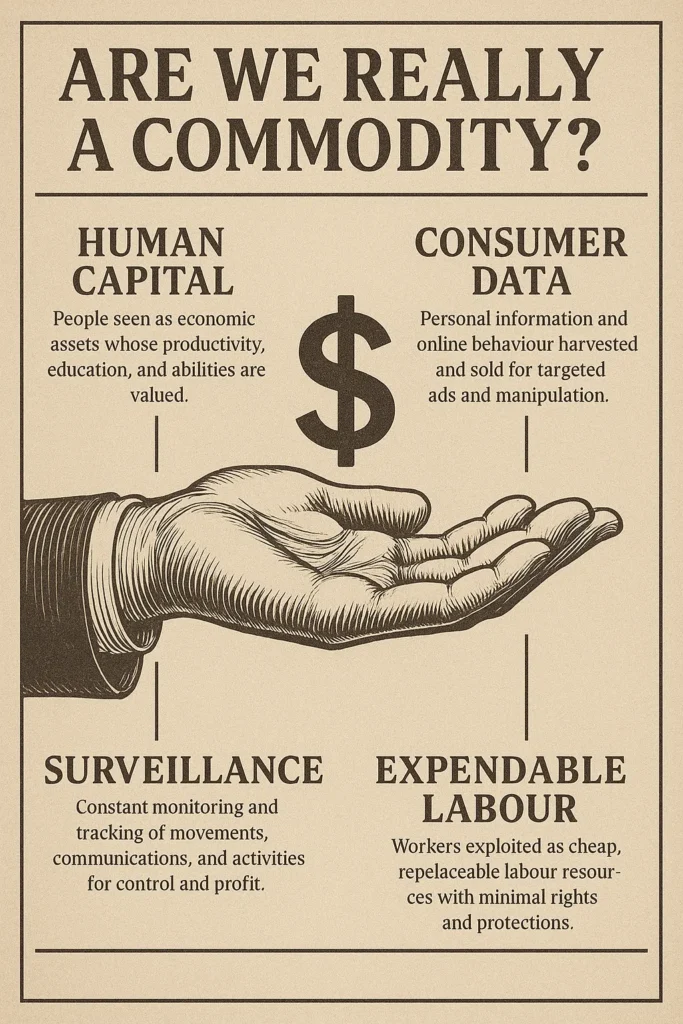
Workplaces demonstrate commodification better than any theory. Employees become resources to optimise, not people to nurture. Spreadsheets don’t care about humour, kindness, or creativity. They measure output. Businesses say “people are our greatest asset,” but staff feel treated like office printers: useful, replaceable, and upgraded when convenient. The gig economy makes this blunter. Drivers, couriers, and freelancers are shuffled like cards in a deck. Algorithms decide who works, who waits, and who disappears. Therefore, “Are we really a commodity” is visible in every payslip, rota, and redundancy notice. From a Flat Earther’s view, workers aren’t standing on a spinning ball; they’re stock shuffled across invisible balance sheets.
The Digital Age and Are We Really a Commodity
Digital life perfected commodification. Data replaced oil as the world’s most valuable resource. Every click, search, and like generates profit. Platforms feel free, yet users are the products. Attention is sold to advertisers like cows in a marketplace. Moreover, the longer we stay online, the higher our auction price climbs. Worse, we participate willingly. We hand over personal details, letting algorithms know us better than family. They predict moods, purchases, and patterns. Consequently, adverts stalk us like shadows. A pizza night becomes trainers flashing across screens by morning. Coincidence? No chance. That’s commodification working with precision. If aliens wanted to study us, they wouldn’t need probes. They could buy the data directly. Therefore, “Are we really a commodity” doesn’t sound dramatic online. It sounds obvious.
Conclusion
So, are we really a commodity? Yes. History shows it. Workplaces reinforce it. Digital systems monetise it daily. From birth certificates to browsing histories, humans are tracked, valued, and traded like stock. The cheeky Flat Earth twist is maybe this isn’t conspiracy at all. Maybe we’re not standing on a spinning globe, but rotating through spreadsheets and stock markets, priced and sold without pause. The real question isn’t whether we’re commodities. The real question is whether we’re content being traded like futures contracts on an exchange we never chose to join.


