




.svg)


Understanding CBDC is it entrapment
The debate around Central Bank Digital Currencies grows louder every day. People now ask the crucial question: CBDC is it entrapment, or is it genuine progress? Governments and central banks promote these digital currencies as modern, efficient, and safer than cash. At first glance, that seems like a natural step forward. Yet money has never been only about buying and selling. It acts as a tool of control. Each time money changes form, power shifts hands too. When physical notes give way to programmable digits, progress often disguises a squeeze on personal freedom.
The debt illusion and the CBDC solution
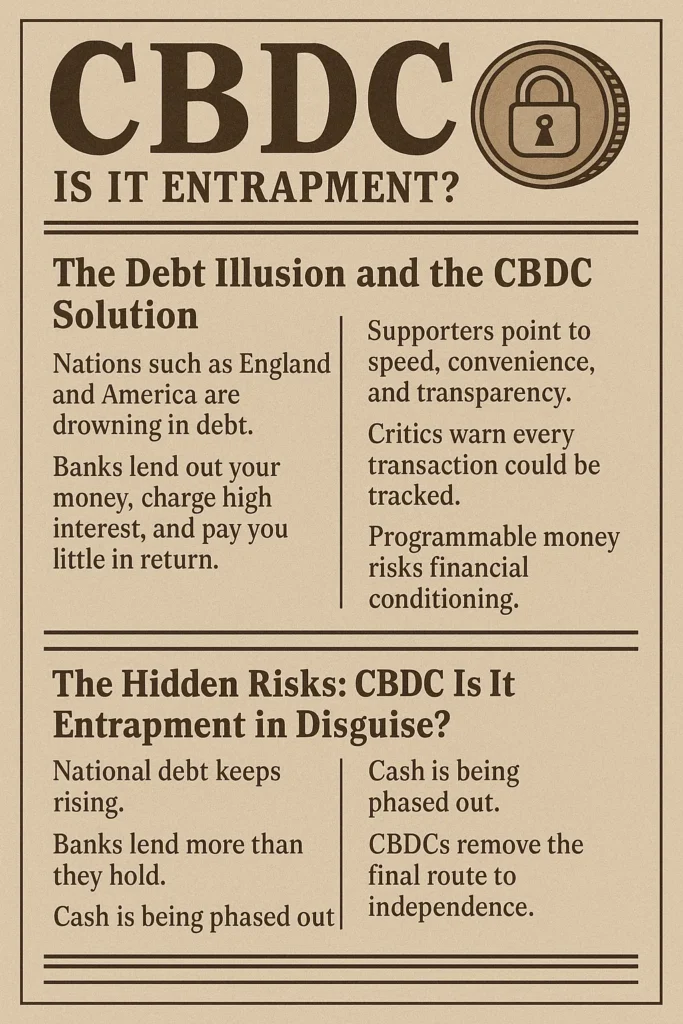
To understand why CBDCs are being pushed so hard, we need to look at the bigger financial picture. Nations such as England and America are drowning in debt. Trillions pile up year after year, with no realistic plan to pay them back. The system staggers on only because people continue to believe it works. Agenda 2030 What is it?.
Banks play their part in this fragile arrangement. They use fractional reserve banking, which means they keep just a slice of deposits and lend out the rest many times over. If everyone demanded their savings tomorrow, the banks would collapse in hours. They lend your money, charge borrowers heavy interest, and return almost nothing to you.
This is the stage where CBDCs enter the story. Without cash, people cannot spark bank runs. There is nothing physical to withdraw. Instead, money stays locked inside the digital system. For central banks, this removes risk. For the public, it raises the question once again: CBDC is it entrapment disguised as innovation?
CBDC is it entrapment or progress?
Supporters of CBDCs claim they represent the next stage of money. They point to speed, convenience, and transparency as undeniable benefits. To them, digital currency looks like progress. However, critics paint a very different picture. Every single transaction leaves a digital trail, and privacy disappears the moment cash vanishes.
Even more worrying is the reality of programmable money. Imagine a digital pound that expires if you don’t spend it fast enough. Or credits that work only in approved shops. That does not look like freedom. Instead, it feels like financial conditioning dressed as innovation.
Therefore, when people ask, CBDC is it entrapment, they raise a fair question. They recognise that once cash disappears, opting out is no longer possible. What some call progress may actually mean dependence.
Why control is the real issue
CBDCs do not arrive in isolation. Instead, they link directly to digital IDs, smart city systems, and constant surveillance. Each piece may seem harmless when viewed alone. Yet together, they form a web of control.
In such a system, obedience earns rewards while dissent faces punishment instantly. Authorities would not need to chase or argue. They could freeze a wallet with one decision. One click, and your access to food, travel, or daily life stops.
This is why many argue CBDC is it entrapment at its very core. The debate is not about efficiency. It is about control over people, not money. BritCard Digital Identity.
The hidden risks: CBDC is it entrapment in disguise?
When you take a step back, the risks become clear.
-
National debt keeps rising with no sign of slowing down.
-
Banks already lend far more than they actually hold.
-
Cash is being phased out at a rapid pace.
-
CBDCs remove the final route to financial independence.
Because of these points, the question CBDC is it entrapment no longer sounds dramatic. Instead, it feels entirely reasonable. The glossy language of inclusion and safety hides a very different reality.
Governments present CBDCs as modern, fair, and efficient. Yet history shows us that centralised control rarely benefits ordinary people. A digital pound or dollar may seem harmless at first. However, once it embeds itself in the system, stepping back becomes almost impossible.
The danger lies in the velvet trap. At first it feels soft, safe, and convenient. Over time, the walls close in, and choice disappears. Once physical cash is gone, independence fades with it.
So the answer to the question CBDC is it entrapment is not just a theoretical debate. It is a challenge to freedom itself. What is being sold as progress may, in truth, be nothing more than obedience wrapped in technology.


