


.svg)


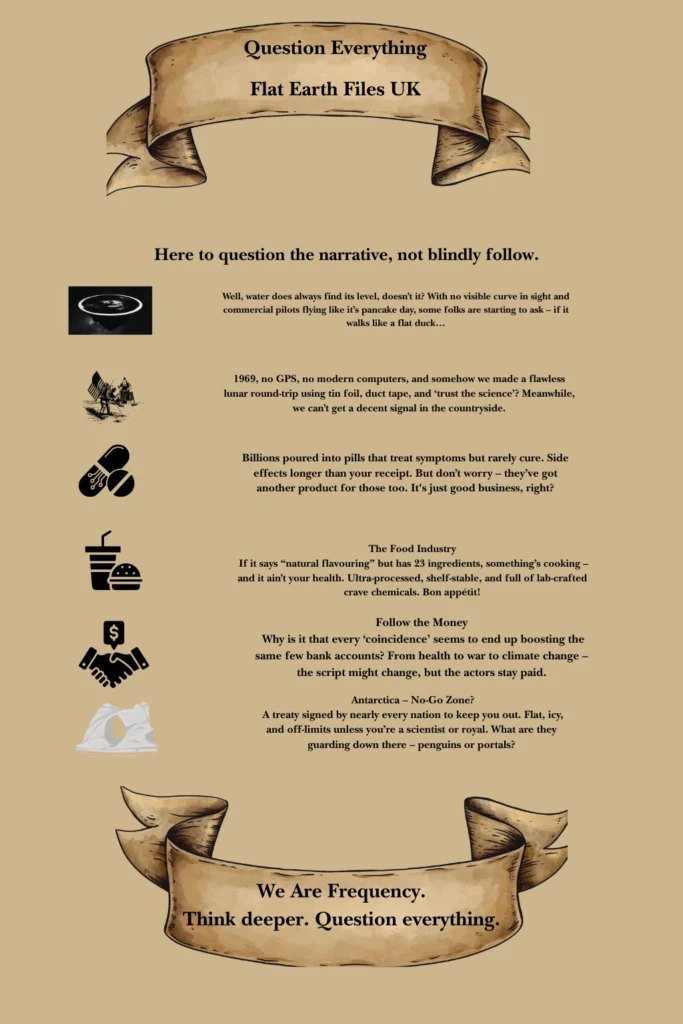
The Ultimate Flat Earth Files UK: What They’re Hoping You’ll Never Notice
We grew up spinning classroom globes and watching space documentaries. But what if things aren’t quite as they seem? Some believe the Flat Earth Files UK hold clues that challenge the spinning-sphere narrative, using simple observations and plenty of cheeky questions.
Curiosity often starts when people notice a gap between what’s taught in textbooks and what they experience with their own eyes. That’s when the questions begin—and they’re not easily dismissed.
Flat Earth Files UK and the Straight Horizon Mystery
Try standing somewhere with a full panoramic view—perhaps a beach, cliff edge, or high-rise window. Notice the horizon? It stays flat no matter how high you go.
From left to right, nothing curves. It’s an uninterrupted, level stretch. Doesn’t that seem odd for a sphere?
Unsurprisingly, the Flat Earth Files UK spotlight this as more than a coincidence. For them, it’s a significant detail.
Balloon launches and drone footage by enthusiasts repeatedly show the same thing—no obvious bend in sight, just a flat expanse.
Pilots follow their instruments and maintain straight flight paths over long distances. If Earth were curved, constant adjustments would be essential—but they don’t make them.
Many photographers report seeing distant landmarks that, by all globe-based calculations, should be out of sight. They use powerful zoom lenses to reveal skylines and islands that shouldn’t be visible.
These repeated observations, gathered over time, offer an alternative perspective that many feel deserves proper attention.
High Flyers and Hollow Claims: What the Flat Earth Files UK Suggest About Satellites
We’re taught that satellites orbit the Earth, bringing us GPS, internet, and weather reports. But is that really how it works? According to the Flat Earth Files UK, the truth may be floating a lot closer.
Every year, space agencies release thousands of high-altitude balloons. These balloons carry equipment that looks and functions a lot like satellites.
Meanwhile, satellite TV signals often disappear during storms. This seems odd if satellites are hundreds of miles above the weather, doesn’t it?
On top of that, most “photos” of Earth are composite images. Even NASA admits many are stitched together from smaller data sets. Why not show us a real, unedited photo?
To flat Earth theorists, this signals a much simpler explanation. Balloons and towers likely play a bigger role than most realise.
Furthermore, fibre optic cables transmit most internet traffic. So, despite all the satellite talk, most data never leaves the ground.
Flight Paths: A Flat Earth Files UK Head-Scratcher
Let’s talk air travel. Some long-haul flights follow puzzling routes. For instance, flights from South America to Australia often refuel in North America.
That might seem inefficient. However, when viewed on a flat Earth map, the route appears perfectly straight. The Flat Earth Files UK highlight many examples like this.
Emergency landings provide even more intrigue. Planes sometimes divert to cities that seem way off-track on a globe. Yet on a flat map, they’re right along the flight path.
Furthermore, flights almost never cross Antarctica. In theory, it should offer the shortest route between many southern destinations. Still, airlines avoid it completely.
These patterns, while strange on a globe, make far more sense on a flat plane. That’s enough to make anyone curious.
The Gravity Dilemma According to Flat Earth Files UK
Gravity is the glue that holds everything down—so we’re told. But could there be a simpler explanation?
Flat Earthers suggest that density and buoyancy do the job just fine. In the Flat Earth Files UK, they argue that things fall or rise based on their weight and the medium around them.
If something’s heavier than air, it drops. If it’s lighter, it floats. No invisible force required.
Besides that, water always finds a level. It doesn’t curve or bulge. Oceans stay flat—no matter the size.
Also, gravity’s selective behaviour raises eyebrows. It holds oceans firm yet allows birds to glide effortlessly. That sounds inconsistent, doesn’t it?
This idea may sound outlandish, but it’s rooted in everyday observations. That’s exactly why people continue to question it. Apollo 11 facts.
Antarctica: The Final Border?
Antarctica is cold, remote, and strictly regulated. Yet, according to flat Earth thinkers, it might be much more than that. The Flat Earth Files UK explore the possibility that it acts as a massive ice wall encircling the flat Earth.
Surprisingly, independent exploration is restricted. Only certain groups are allowed access under strict treaties.
Additionally, commercial airlines don’t fly over Antarctica. That’s strange, especially given the fuel savings it could offer.
Why the secrecy? What exactly are they protecting?
Supporters of the flat Earth model believe the ice wall holds the oceans in place. While it sounds far-fetched, the lack of public access raises legitimate questions.
If there’s nothing to hide, why make it so hard to visit?
Conclusion: Stay Curious, Ask Questions
The Flat Earth Files UK aren’t about telling you what to think. Instead, they encourage you to ask your own questions.
You’ve seen the flat horizon. You’ve noticed strange flight paths. You’ve watched as satellites go offline in bad weather.
Is the Earth flat? That’s up to you. What matters more is curiosity—asking “why” and not being afraid of the answer.
After all, it’s never foolish to seek the truth—even if it’s hiding in plain sight.
FAQs
1. What are the Flat Earth Files UK?
They’re a compilation of ideas and observations that challenge mainstream Earth science.
2. Are satellites really balloons?
Thousands of documented balloon launches suggest they might be.
3. Why do flight paths make no sense?
They don’t on a globe. On a flat map, many become straightforward.
4. How do flat Earthers explain gravity?
With density and buoyancy—simple forces seen in nature every day.
5. Can I travel across Antarctica?
No. Access is restricted by treaty, and only guided tours are permitted.
Here are a couple of other posts you may well like.
Operation Popeye – Weather Warfare and Cloud Seeding Exposed
Hidden Truth About EMF: How The ‘G’ Rollouts Impact Your Health


