


.svg)


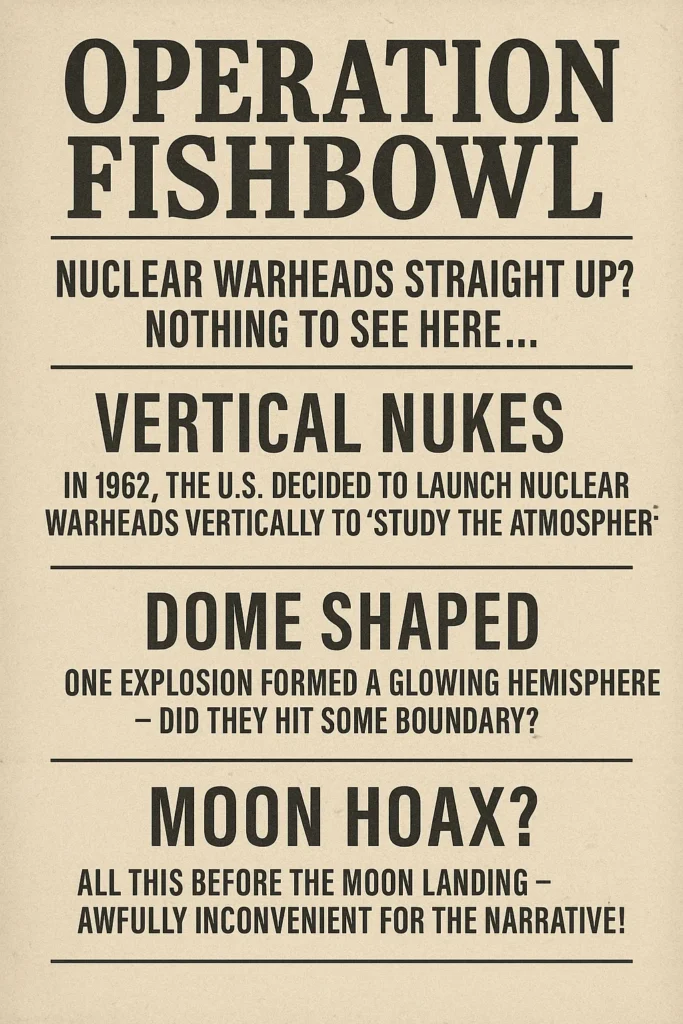
Operation Fishbowl: Did They Hit the Firmament?
Let’s talk about Operation Fishbowl—one of the most suspiciously named Cold War experiments in military history. Because, really, when governments start launching nuclear warheads directly upwards, shouldn’t we be asking why?
And more importantly—why did the sky react like it hit a wall?
The Strange Case of Operation Fishbowl
So, what was Operation Fishbowl? Officially, it was a series of high-altitude nuclear tests conducted by the United States in 1962. The aim? To study the Earth’s upper atmosphere and observe how nuclear explosions behave in space.
However, what actually happened is much more bizarre. When the nukes went off, they didn’t vanish into the void like fireworks in a vacuum. Instead, the explosions seemed to ripple—flattening out against something. Something invisible. Something… firm.
Even without a tinfoil hat, that’s hard to ignore.
Why the Name ‘Fishbowl’?
Of all the names available, why choose Fishbowl?
They could’ve gone with “Skyburst,” “Orbital Thunder,” or even “Stratoshock.” But no—they chose a term that suggests containment. A dome. A sealed environment.
Many flat Earth believers consider this name a quiet nod to the idea of a firmament—a barrier enclosing our world. Coincidence? Perhaps. But even the most sceptical must admit: it’s oddly specific for a mission involving nukes fired straight up.
The Explosions Looked Like They Hit Something
Let’s address what really fuels suspicion. The footage from Operation Fishbowl reveals something strange. Instead of dispersing endlessly, the nuclear explosions appear to hit an invisible surface and then spread outward.
Rather than expanding spherically, they flatten. They form giant rings and strange light patterns. If space is empty, why do the blasts behave as if they’re slamming into glass?
Some scientists blame it on magnetic fields or atmospheric effects. That’s a neat explanation. Still, others see it differently—they see an impact. A failed attempt to break through.
Operation Fishbowl and the Dome Theory
Flat Earthers love this one—and honestly, it’s not hard to see why.
According to the dome theory, Earth is enclosed by a physical barrier—the firmament. This concept isn’t new. It goes back to ancient texts and cultural myths. What’s new is the idea that governments might’ve tried to blow a hole through it.
That’s where Operation Fishbowl fits in. Perhaps it wasn’t about science at all. Perhaps they were testing the limits—trying to breach the dome and failing.
Of course, they wouldn’t announce that on the evening news.
Was Operation Fishbowl a Cover for Something Bigger?
Let’s think this through. What if the mission was never just about atmospheric data? Maybe it was a full-scale attempt to reach something humanity wasn’t supposed to touch.
If they did encounter resistance, would they admit it? Probably not. Instead, they’d issue technical reports, bury the footage, and call it classified. Job done. Curiosity controlled.
The public? Fed a few grainy clips and told to move on. Mission accomplished. High-Altitude Balloon Flat Horizon Debate
Who Gains by Keeping This Quiet?
It’s easy to say, “Well, if that were true, someone would have leaked it.” But ask yourself—who benefits from silence?
Space agencies rely on the idea of an infinite universe. So do governments, corporations, and science institutions. If there’s a ceiling above our heads, the entire space narrative begins to unravel.
Therefore, if Operation Fishbowl provided evidence of a boundary, the simplest option would be to suppress it. Keep the narrative clean. Keep the funding flowing. Who really controls the world.
Why Don’t We Hear More About It?
Have you ever noticed how few people even know about Operation Fishbowl?
It’s rarely mentioned in history books. Documentaries skip over it. The media ignores it. Meanwhile, the footage sits online, unexplained and undiscussed.
If this was just another nuclear test, why the silence? Could it be because the evidence doesn’t fit the official story?
When people do bring it up, they’re dismissed as conspiracy theorists. But history shows that the line between theory and fact can blur quickly—especially when governments are involved.
What Can You Do About It?
Start by watching the actual footage. Look with your own eyes. Then, ask questions. Explore both sides. Keep an open—but sharp—mind.
Also, share what you learn. Bring it up. Start conversations. Because knowledge spreads faster than secrecy.
Most importantly, remember that questioning doesn’t make you gullible—it makes you awake.
Conclusion: Ask the Questions They Avoid
Operation Fishbowl is more than a Cold War relic. It’s a curious, explosive moment in history—literally. And while scientists talk about radiation belts and ion storms, the rest of us are left wondering if they hit something bigger than air.
We’re not saying Earth is flat. We’re saying the sky reacted strangely to a nuclear bomb—and that’s worth a real conversation.
So go ahead. Ask the questions. Because sometimes, the only thing separating science from mystery is a well-placed explosion.


