


.svg)


Dimming the Sun: Follow the Money
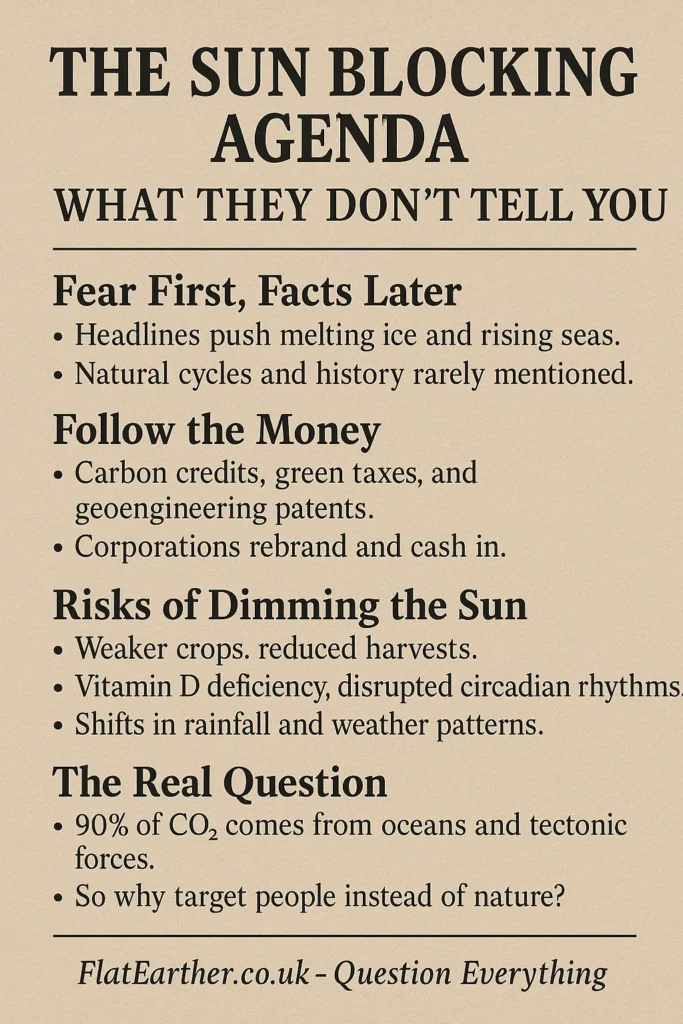
Public messaging now treats climate as a crisis that demands urgent, top-down fixes. However, the Sun Blocking Agenda conversation skips past a crucial point: nature moves most of the carbon. Oceans exchange vast amounts of CO₂ with the air, and tectonic processes vent more through volcanoes and deep-sea fissures. Meanwhile, officials still point at cars, boilers, and burgers. Consequently, the story narrows, and the proposed “solution” widens to the sky itself. In short, the sun blocking agenda steps forward as the hero no one actually asked for.
Naturally, people want a safe planet. Yet, we should also want honest framing. Because history shows dramatic climate swings before smokestacks, we ought to ask tougher questions. Therefore, when institutions rush to dim the Sun, we should inspect motives, money, and long-term side effects, not just the marketing.
The Sun Blocking Agenda and Fear
Fear moves crowds faster than facts. Repeated images of flooding streets and burning forests stir urgency; then proposed fixes arrive pre-packaged. Moreover, headlines rarely mention multidecadal ocean cycles, historical warm periods, or the complex dance between water vapour, clouds, and solar activity. Instead, the frame centres on personal guilt and instant sacrifice.
Because fear simplifies choices, extreme measures start to look reasonable. Politicians announce “temporary” sky experiments; consultancies draft frameworks; activists applaud. Meanwhile, dissenters face smears, not debate. Consequently, the sun blocking agenda slides from “controversial idea” to “necessary step” without the public ever holding a real vote. And once a lever exists to dim sunlight, power naturally concentrates around whoever grips that lever.
Who Profits from the Sun Blocking Agenda?
Follow the money, and the scenery changes. Carbon schemes create tradable credits; compliance markets expand; geoengineering patents multiply. Additionally, the same legacy energy giants rebrand as “solutions providers” and secure fresh subsidies. Universities chase grants; NGOs gain campaigns; startups pitch aerosols, mirrors, and reflective particulates like they’re the next big app.
Furthermore, agriculture sits in the blast radius. Plants need full-spectrum sunlight for robust photosynthesis. Reduce sunlight and you risk weaker crops, lower nutrient density, and tighter margins for farmers. Consequently, supply chains wobble first, then prices rise, and ordinary families pay. Yet the brochures stay glossy, and the panels stay upbeat. Because profits look tidy on spreadsheets, the human costs fade into footnotes. Inevitably, the sun blocking agenda enriches gatekeepers while shifting risk onto everyone who eats, farms, or works outdoors.
Why the Sun Blocking Agenda Risks Real Harm
Let’s speak plainly. Every living system on Earth evolved under the Sun. Therefore, when planners propose dimming that light, they propose rewriting biology. Reduced UV exposure can depress vitamin D levels; weaker cues can scramble circadian rhythms; altered light can reshape growth cycles in plants and algae. Moreover, regional rainfall patterns may shift, since sunlight drives evaporation, convection, and cloud dynamics. Because climate is a web, not a thermostat, tugging one strand vibrates the rest.
Supporters promise reversibility. Yet aerosols can linger; feedback loops can surprise; political incentives can harden. After all, if a nation leans on dimming to hide underlying problems, what happens when it stops? Consequently, temporary fixes often become permanent crutches. Global Warming Scam: What They Don’t Want You to Question
Is the Sun Blocking Agenda About Control?
Words matter. “Change” sounds natural; “control” sounds managerial. However, dimming sunlight looks exactly like management. Whoever sets the dosage, timing, and geography effectively sets farming calendars, regional water cycles, and energy planning. Moreover, control of inputs begets control of outcomes. If you can dial the light, you can tilt advantage toward some regions and away from others. Therefore, the question shifts from science to sovereignty: who decides, who audits, and who pays when things go wrong?
Question Everything — Then Follow the Evidence
Because oceans and tectonics drive most CO₂, blaming only daily life never told the whole story. Yet the proposed remedy reaches for the sky, not for nuance. Therefore, keep asking: who drafts the models, who funds the pilots, and who gains durable revenue streams if dimming becomes policy? Moreover, demand open trials, public consent, and full liability, not just bright graphics and press releases.
In the end, a healthy planet needs sunlight, honest science, and accountable institutions. The sun blocking agenda offers shortcuts that look clever on paper and costly in practice. Consequently, it deserves scrutiny at every step. So, question the framing, read the fine print, and always follow the money. When you do, the pattern becomes hard to miss: fear centralises power, profit cements it, and sunlight — life’s oldest ally — becomes a variable on someone else’s dial.


