



.svg)



The Law of the Land – Who Really Writes the Rules?
Everyone talks about the law of the land, yet few stop to ask what it truly means. Governments claim it protects justice, equality, and order. However, every policy, bill, and regulation seems written to defend the powerful, not the people. Once you begin examining the fine print, it becomes clear that law isn’t always about truth — it’s often about control, wrapped in persuasive language.
The Law of the Land or the Law of the Sea?
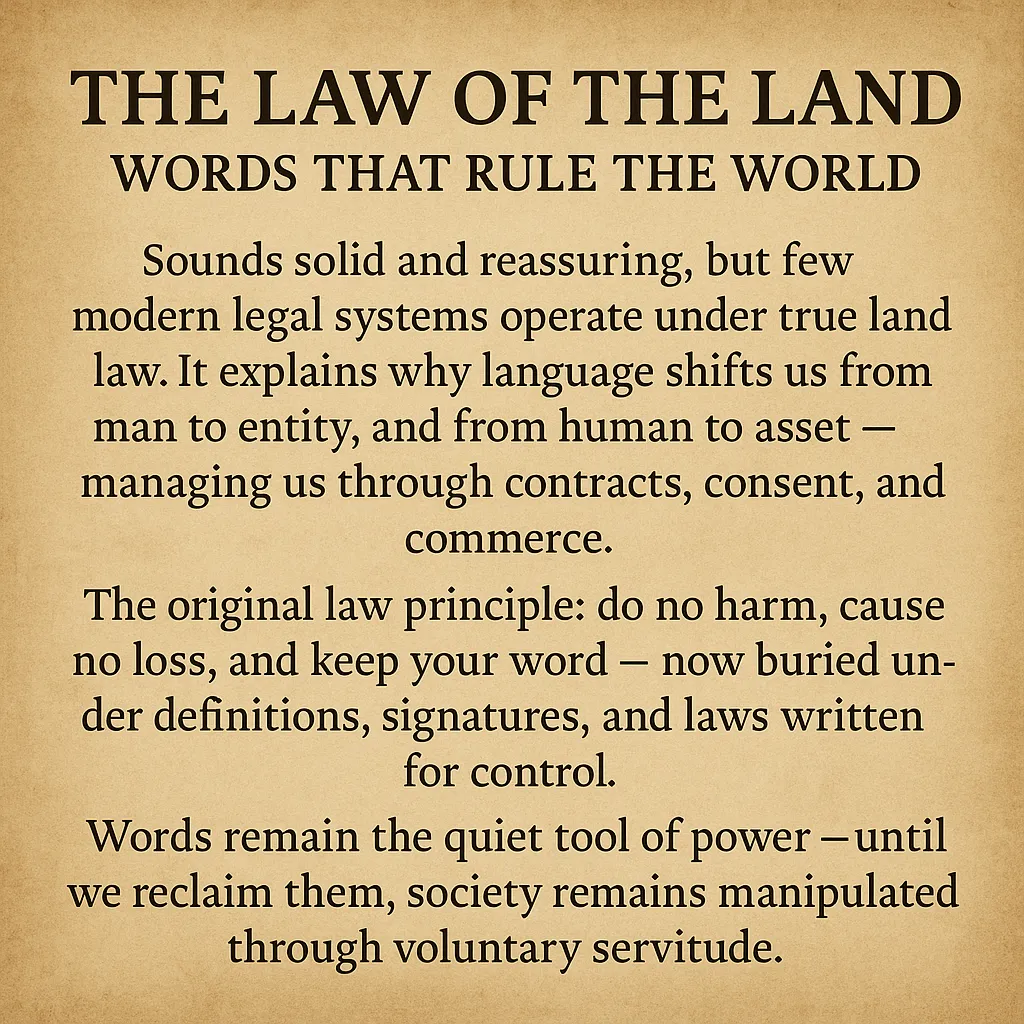
At first glance, living under the law of the land sounds secure, balanced, and fair. However, most modern systems operate under something resembling maritime or corporate law instead. It explains why we “register” births, “licence” freedoms, and “submit” forms — all words of consent and contract. Each term drags us from land to sea, shifting us from living beings to legal entities.
That quiet transition reshaped society. Instead of being recognised as human, we became managed assets inside a commercial structure where consent is assumed. Natural freedom gave way to regulated existence. Those changes didn’t happen by accident — they happened through careful wording that most people never question.
The Fine Print They Don’t Want You to Read
Legal documents are rarely designed for understanding. Long sentences, coded terms, and obscure phrases keep people in confusion. It’s intentional. Many assume “legal” and “lawful” mean the same, but they don’t. Legal means “permitted within the system,” while lawful means “aligned with natural justice.” That difference transforms everything. The law of the land once protected people from exploitation, yet legal systems now protect institutions from accountability. Freedom of Speech Limitations UK – Are We Really Free?
Once this truth clicks, everything starts to look different. Every regulation reveals double meanings. Every contract shows hidden intent. Language becomes the ultimate weapon — one that shapes nations and binds people without their awareness. It’s control through consent, disguised as order.
Land, Sea, and the Great Illusion of Consent
Imagine standing on firm ground but being judged by rules meant for ships. That’s how modern law operates. Courts, docks, and procedures all echo maritime language because society is processed as cargo, not as living men and women. The system relies on silence. When you sign, agree, or stay quiet, you give permission to be governed by their terms.
Still, the law of the land remains simple at its core: do no harm, cause no loss, and keep your word. Those principles existed long before governments. People lived freely by them because nature demands balance. Over centuries, corporate charters buried that simplicity under commercial codes. Honour became paperwork. Integrity turned into signatures.
Reclaiming the Law of the Land
True change begins with awareness. Once you recognise how deeply language defines authority, you start to step outside the system. Learn the difference between common law, statutory law, and corporate law. Common law protects individuals. Statute law serves governments. Corporate law prioritises profit. Understanding that hierarchy helps you reclaim your sovereignty.
Keep asking questions. Must we seek permission for what was once natural? Why do fines and taxes outweigh fairness and reason? Why are our rights treated like privileges that can be revoked? As your understanding grows, you realise how power survives through ignorance. Awareness alone breaks the cycle. Living by the law of the land means honouring truth over convenience.
Words That Rule the World
Language builds worlds, and those in control know it well. They twist meanings, rename freedoms, and redefine justice to keep people compliant. Yet every time someone questions their narrative, that spell weakens. Reading, questioning, and sharing knowledge are acts of quiet rebellion. Once you speak truth, you no longer consent to deceit.
The real law still exists beneath the surface. It’s older than governments and stronger than any statute. When you live by natural principles — honesty, fairness, and respect — you return to the law of the land, not the law of manipulation. Freedom doesn’t arrive through politics; it begins with understanding how words have been used to enslave minds.


