




.svg)


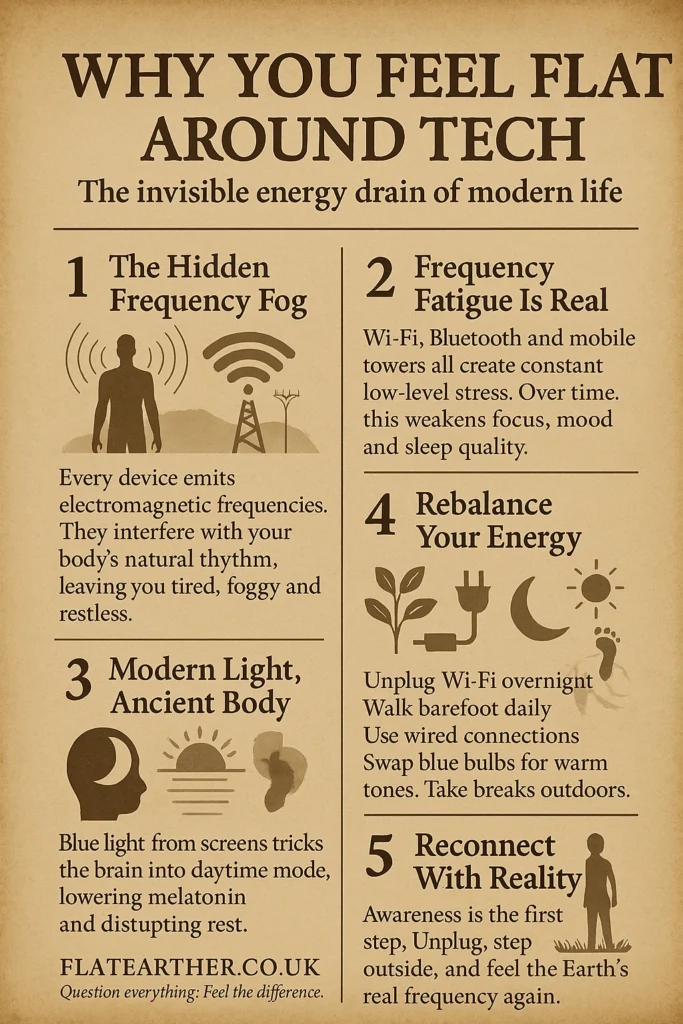
Why You Feel Flat Around Tech – The Invisible Drain on Your Energy
Ever wondered why you feel drained after a long day near screens? It’s not just tired eyes. The truth is, most people never question why they feel flat around tech. We simply accept the fatigue as part of modern life. Yet something deeper is happening, something that goes beyond caffeine crashes or late nights.
Every digital device gives off electromagnetic frequencies — unseen energy fields that surround you all day long. Your body runs on its own electrical rhythm, so constant interference leaves you unbalanced. You start to feel foggy, restless, or strangely low, even when you’ve done nothing physical. That’s the modern mystery: why you feel flat around tech, even when you haven’t moved an inch.
Why You Feel Flat Around Tech. Our ancestors didn’t deal with this invisible noise. They lived in tune with the Earth’s natural frequency — a steady hum that kept their systems grounded. Today, we’re bathed in artificial signals 24/7. Wi-Fi routers, Bluetooth, mobile towers, smart meters — all whispering through the air, all competing with the body’s internal code. The Silent Frequency War – What They’re Really Zapping You With
Frequency Fatigue and Modern Life
Why You Feel Flat Around Tech. Science admits the human heart and brain produce measurable electromagnetic fields. When outside interference overlaps those frequencies, the body struggles to maintain balance. The result is what many now call “frequency fatigue”. That’s the true reason why you feel flat around tech.
Think about it. Waking up to an alarm from your phone. You scroll through headlines, messages, and memes before breakfast. You sit beneath LED lights, surrounded by screens and signals. By mid-day, your energy has quietly leaked away. No surprise you crave sugar or caffeine — your body’s trying to reboot.
Even blue light from devices disrupts your melatonin cycle. That means less deep sleep, more mental haze, and a weaker immune system. Every swipe, ping, and vibration is a mini jolt to your nervous system. And still, most people never stop to ask why they feel flat around tech.
Steps to Stop Feeling Flat Around Tech
You don’t need to ditch your gadgets completely, but you can take back control. Try these simple habits to reduce your exposure and boost your natural energy flow.
-
Unplug at night. Turn off Wi-Fi routers and keep your phone on flight mode. Your body heals best without background interference.
-
Ground daily. Walk barefoot on grass or soil. It helps discharge static energy and realign your body to Earth’s frequency.
-
Use wired connections. Ethernet cables might look old-school, but they cut your exposure dramatically.
-
Filter your light. Swap blue-white bulbs for warm amber tones, especially in the evening.
-
Take screen breaks. Every hour, step outside or look at the horizon. Let your eyes and mind reset.
Follow these and you’ll notice the fog start to lift. It’s amazing how different life feels when you step outside the frequency cloud. That dull tiredness you thought was “just life”? It begins to fade.
Final Thoughts on Why You Feel Flat
The modern world runs on invisible currents. Most can’t see them, so they don’t question them. But understanding why you feel flat around tech gives you the power to change it. Awareness always comes before freedom.
Technology isn’t the enemy — imbalance is. Use your devices wisely, and they’ll serve you without draining you. Keep them close all day and you’ll keep feeling flat. The trick is to live by nature’s code again: light in the morning, stillness at night, and moments offline in between.
So next time you catch yourself feeling drained indoors, don’t just blame your workload. Remember the hidden frequency fog that hums through modern life. Once you start to see it, you can finally rise above it. The 2020 Frequency Shift – The Truth Behind the Tech Takeover


